Preventing Habituation : 2009
- People adapt expertly and soon become accustomed to the experiences supplied by the environments and things that surround us. Habituation is the diminishing pleasure obtained upon successive occasions of having a particular experience. There are only two mechanisms to counteract habituation - variety of experiences and time between them.
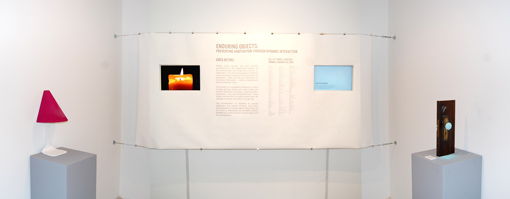
This project investigates methods by which a single dynamic object can create variety and prevent habituation, including: responsiveness, wear and unexpectedness. The development of methods to prevent habituation and extend, enhance, and enrich the experience of human-object interactions will be crucial to addressing the inevitable collision between the current culture of consumption and its consequences.
Candle Lamp
I tested thermochromic ink on a wide variety of materials and finishes, but fabrics had the most interesting effects. While experimenting with fabrics and lightbulbs, I found that the color change could reference the previous source of light - candle flame. The shape of the shade was designed to create that pattern, and the form of the lamp body was borrowed from an archetypal candlestick.
In the same way that flame captures our interest, this lamp is continually changing.
Wabi-Sabi Doorknob
The wabi-sabi aesthetic is an established philosophy that engages directly with time and the human-object dialogue. These doorknobs, like all wabi-sabi objects, are crafted with the knowledge that they will evolve over time and are tangible expressions of moments in time. Materially, they are visibly mutable, self-recording the history of human use, misuse, and interaction.
This project required creating a new kind of 'chalk' soft enough to easily rub off on one's hand, but resilient enough to function as a doorknob. After much experimentation, a castable non-toxic mixture was developed that could be tinted with food-safe coloring.
- Next >